
This Hotel Event Contract Clause Almost Cost a Volunteer $42,000 Out of Pocket
What every event planner, board member, and executive assistant needs to know before signing a hotel event contract
There's a real story behind that number. A good volunteer at a small nonprofit who stepped up to plan the annual gala, nearly became personally liable for $42,000. Not the organization. Her. Personally.
The culprit was a single clause in a standard hotel event contract. One that most people skip because the word alone makes their eyes glaze over.
That word is indemnification.
What Is Indemnification in a Hotel Event Contract?
Indemnification is a legal agreement where one party promises to protect another party from financial losses, legal claims, or damages. In a hotel event contract, the indemnification clause typically requires the "Client" (that's you) to cover the hotel's legal costs and losses if something goes wrong at your event.
Here's what it often looks like in practice:
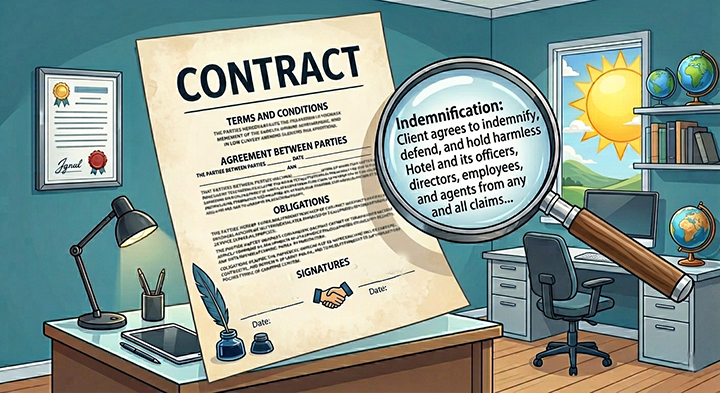
"Client agrees to indemnify, defend, and hold harmless Hotel and its officers, directors, employees, and agents from any and all claims..."
Read that carefully. Any and all claims. Including claims that have nothing to do with you.
Why the Indemnification Clause in Hotel Event Contracts Is So Dangerous
The risk isn't just financial, it could be personal.
Say a guest at your event has too much to drink. They slip on a wet floor in the hotel lobby. They sue. The hotel's insurance lawyers look at the contract and ask who is the "Client"? If the contract was signed in your personal name, or if your organization's name isn't clearly attached to your signature, the answer is you. Personally. The hotel's legal team can come after your savings and your house to defend the hotel from a claim caused by their own wet floor.
This is the scenario that played out for the nonprofit volunteer. The contract hadn't been reviewed. The indemnification clause was signed as-is. And she was left exposed.
This is exactly the kind of risky clause that the hotel event contract review at EventNation was built to catch automatically, for free, before you sign.
Who Is Most at Risk?
The people most exposed to indemnification liability in hotel event contracts are often the least equipped to spot it:
Nonprofit board members and volunteers planning an annual gala or fundraiser
Executive assistants coordinating their first company off-site
Committee chairs who inherited event planning responsibilities
New event coordinators without a legal team behind them
These are people who are handed a 20-page hotel contract, told to "just get it signed," and have no idea that a clause on page seven could cost them a lot.
The Three Negotiation Requests That Change Everything
Here's the good news: hotels expect you to negotiate this clause. They send you the most aggressive version of the contract on purpose. Most planners sign it without question. The ones who push back almost always win.
There are three specific asks that address the indemnification clause in a hotel event contract. They take about five minutes to write. And they matter enormously to reduce your financial (and emotional) risk.
1\. Limit indemnification to the contracting organization — not the individual signing.
You should not be liable for any financial risk. The organization's legal entity should be the contracting party, full stop.
2\. Exclude liability arising from the hotel's own negligence or willful misconduct.
You should not be responsible for protecting the hotel from the consequences of its own actions. If their floor is wet and someone falls, that's on them.
3\. Make it mutual.
The hotel should indemnify you for their actions, and you indemnify them for your organization. That's a fair contract. The one-sided version they sent you is not.
In practice, hotels do not walk away from deals over these matters. The business is too important to them. What they're counting on is that you won't even ask.
How to Find the Indemnification Clause in Your Hotel Contract
It's usually buried on a later page, not page one. Look for the words "indemnify," "defend," "hold harmless," or "indemnification." The language is intentionally dense. That's not an accident.
If you're struggling to find the indemnification clause, or to decide what it means, that's a signal to get help before you sign. EventNation scans hotel event contracts automatically by stripping private company information before the document is ever scanned, and flagging clauses like this one in plain English, along with the specific changes you should request. (EventNation does not provide not legal advice. EventNation provides education on event industry best practices designed by real, experienced event planners. Always seek legal counsel before signing a contract.)
What Is Indemnification vs. Liability Limitation? (Common Confusion)
These two terms come up together in hotel event contracts, and they're easy to conflate.
Indemnification is an active obligation: a promise to cover someone else's losses. Liability limitation caps how much one party can be held responsible for. Both matter. Both are negotiable. But the indemnification clause carries personal exposure in a way that a standard liability cap does not, which is why it demands specific attention.
The Broader Problem with Hotel Event Contracts
Indemnification is the most dangerous clause, but it's not the only one. Hotel event contracts are written by hotel lawyers, for hotel interests. The attrition clause, the force majeure provisions, the walk clause: each one has a version that protects the hotel and a version that's fair to both parties. Most new planners and non-profit volunteers never know the difference because they don't know what to look for.
That knowledge gap is expensive. Not just in legal exposure, but in dollars lost on every contract that goes unreviewed.
EventNation exists to close that gap for volunteers who shouldn't need a law degree to host a fundraiser, and for everyone who's ever signed a hotel contract hoping for the best. Again, please also seek legal counsel before signing. EventNation exists to educate about event industry best practices only, giving you the experience and wisdom of seasoned event planners built right into the software.
Before You Sign: The TLDR Short Version
If you take nothing else from this, take this:
• Find the indemnification clause before you sign any hotel event contract.
• Make sure the contracting party is your organization, not you personally.
•Request mutual indemnification and an exclusion for the hotel's own negligence.
• Hotels do negotiate. But you must ask.
And if you're not sure what you're looking at, get it reviewed. The $42,000 story is real. It doesn't have to be yours.
EventNation is a free, AI-powered hotel contract review platform built to give industry best practices from experienced corporate event planners. Learn more at eventnation.com.
Ready to review your next hotel contract?
Get My Free Contract Review