
Leaky Meetings & Events Spend: Indirect Procurement's Hotel Contract Blind Spot
By Faith Keiser, Founder, EventNation.com
October 27, 2026
The leak of event spend is real, and it is large
A large share of corporate hotel and meetings spend still sits outside any managed program. 76% of travel managers say hotel spend is leaking outside their organization's Strategic Meetings Management (SMM) programs. GBTA, Achieving the Perfect Business Trip, May 20, 2025
The broader research points the same way:
• About half is unmanaged. Roughly 50% of meeting-related spend goes unmanaged, according to a 2024 American Express Global Business Travel survey of 519 meeting professionals, as reported by The Company Dime.
• Few companies have the structure to catch it. Only 32% of corporate travel buyers say their company has a well-developed managed meetings program, and 34% have no defined sourcing process for meeting or venue space at all (GBTA and Cvent, 2025).
• The cost of not catching it is measurable. In that same GBTA and Cvent survey, buyers reported average savings of 22% when meetings go through a defined sourcing process. Unmanaged spend forgoes that.
Here is what this looks like inside one company. A large U.S. financial services firm found about $25 million in meetings and events spend happening outside its core Meetings & Events team, according to a BCD Meetings & Events case study. That is not a rounding error. It is a large spend category nobody was managing.
Who is actually signing hotel event contracts
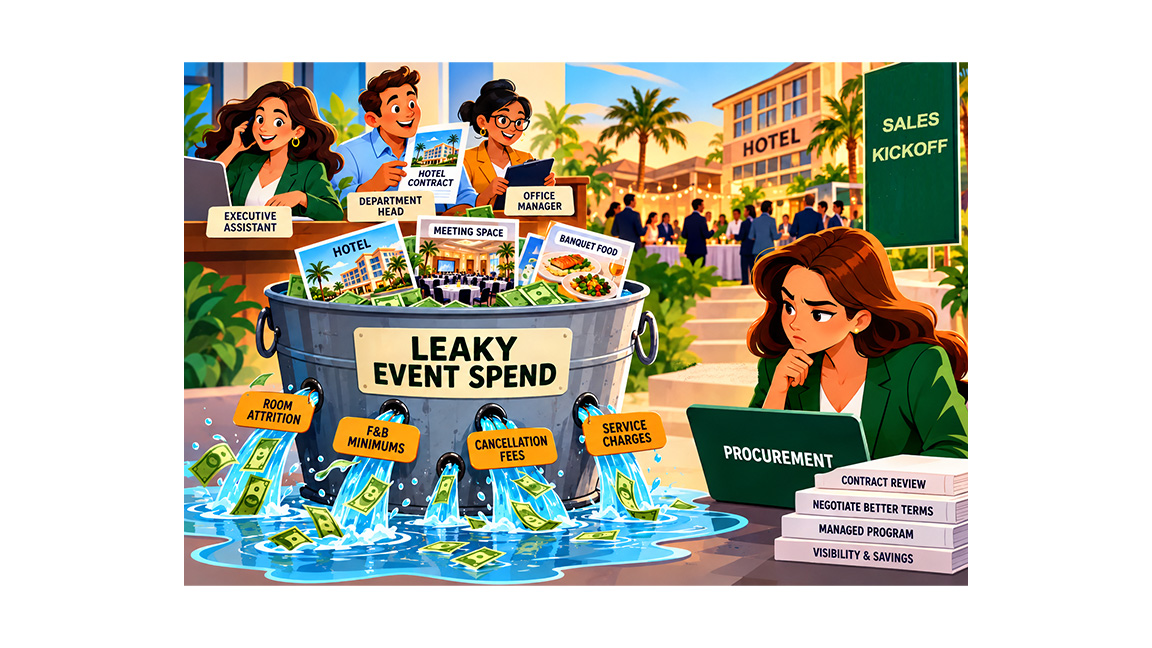
In our experience, much of this spend is committed by executive assistants, office managers, and department heads, not by procurement or a professional meetings team. They book the board retreat, the regional sales meeting, the leadership offsite. Many have little or no experience negotiating a hotel group contract.
That pattern is not new. Consultant Betsy Bondurant made this point in renowned industry trade publication, Smart Meetings (2017). Bondurant said meetings are not a traditional commodity, so they are rarely run through a single procurement department. She estimated that more than half of large and midsize organizations had made no concerted effort to capture their meetings spend.
The BCD case study above lists the same symptoms. The firm had no company-wide meetings policy outside its central team, inconsistent payment methods, and venue contracts signed without procurement or meetings-team involvement.
Some institutions have closed this gap on paper. Columbia University, for example, requires Purchasing to review and approve hotel and event contracts, and Georgia Tech generally limits who may sign event agreements to contracting officers in Purchasing. In our experience, many corporations have no equivalent rule for a five-figure hotel contract signed inside a department.
The fees that arrive after the event, sometimes in a new fiscal year
A hotel event contract commits the company to costs that depend on what happens months later. An experienced negotiator limits those exposures before signing. An occasional signer often doesn't know they are there, what the signer is committing to, or when those costs will appear in an invoice.
Costs that are often a surprise for inexperienced event planners:
• Room attrition: Paying for unused rooms below a pickup threshold, typically 70% to 90% of the room block)
• Food and beverage minimum: Spending a set amount on catering, and paying the shortfall if the group spends less)
• Cancellation damages: Paying a share of the hotel's expected revenue if the group cancels. Usually rises as the event date nears
• Service charges and fees: Percentages and add-ons layered onto food, rooms, audiovisual services, meeting space, wayfinding signage, waste disposal, etc.
The numbers add up quickly. Here are some examples:
• Attrition. Contract 200 rooms for three nights at $150, use only 140, and the shortfall is $27,000 in potential attrition fees (ProStay). Worse, a contract with no attrition clause at all can leave the group responsible for 100% of the block, not the usual 85% (Lauralee Wren, MeetingsMags.com).
• Food and beverage. If a group consumes less than its minimum, it pays the difference between actual spend and the minimum (Colorado Department of Revenue).
• Service and Other Fees. Planners told Skift Meetings that hotel fees can cut into a meeting budget by 30% to 40% or more. One airport hotel menu stacked a 17% gratuity, a 12% administrative fee, a 7% tax and an 8% event fee. Service charges can also rise between signing and the event: one planner told BizBash of a rate that climbed from 22% to 25% over two years from the signing of the contract to the time of the event.
None of these costs appear on the purchase order. They are contingent liabilities created at signature and realized on an invoice that arrives after the event, often paid from a departmental budget.
Why invisible spend is procurement's problem
Spend that procurement can't see is spend procurement can't negotiate, benchmark or protect. Travel buyers already know this: in the GBTA and Cvent survey, they named three costs of planning meetings outside a managed program.
• Higher costs and lost savings (79% of buyers)
• Less data to use in future negotiations (74%)
• Risk management and safety concerns (63%)
The leverage point matters most. When a company can see that most of its meetings land in five cities, or with one or two hotel brands, it can negotiate as a single buyer instead of a dozen small ones. Bondurant described exactly this in Smart Meetings, and estimated that firms commonly cut meeting costs 15% to 20% within two years of starting a program.
The risk point is the one that gets overlooked. Attrition, cancellation and minimum-spend clauses are financial commitments made at signature. If procurement never sees the contract, those commitments never appear in anyone's view of company exposure until the bill arrives.
Making invisible spend visible
You don't need a full SMM program to start. You need to find the contracts signed in the past, see what they commit you to, and put a check in front of the next one.
• Find what has already been signed. Pull hotel and venue payments from P-card, expense and accounts payable data, and look for large single payments to properties. Then ask departments for the contracts behind them.
• Capture each event in a simple record. Bondurant suggested starting with one spreadsheet per department listing destination, hotel brand, lead time, attendees, budget and actual line-item spend.
• Put a review step before signature. Route hotel and venue contracts through procurement or a designated reviewer, such as Columbia University's Purchasing office does. At minimum, check the hotel event contract's attrition threshold, F&B minimum, cancellation schedule, and whether service charges are locked at signing.
• Start with a slice. The BCD client in the case study mentioned above brought $1.6 million of spend into view in its first month, and planned to reach 30% of its unmanaged spend in year one, and 60% by year three. Partial visibility still contains some costs.
This is the heavy lift EventNation was built for. Our AI contract review flags attrition, cancellation, F&B minimum, indemnification, and other financial risks before anyone signs, and it can analyze the hotel contracts a company has already signed across departments to show what better terms would have saved.
Next in the series
This Part 1 was about the size of the leak and why procurement doesn't see it. Part 2 is about what is behind the recent rise in hotel event fees, and how those fees are currently handled by most corporate employees when the post-event invoice arrives.
If you lead Indirect Procurement and suspect hotel and venue contracts
Faith Keiser is Founder of EventNation. For a free, privacy-safe contract scan that estimates event spend leakage and identifies future high-dollar traps before you sign, EventNation offers a complimentary 2-year hotel contract lookback for your organization.

Sources
Meetings Management Lags Travel, The Company Dime (cites 2024 Amex GBT Meetings & Events survey)
Hotel and Meetings Sourcing Enters a New Era, Hotel Online, Aug 2025 (GBTA and Cvent survey, March 2025, n=278)
Financial Services Client SMM Program, BCD Meetings & Events
Capturing and Leveraging Meeting Spend, Smart Meetings, Jan 2017
Hotel & Event Contracting Guidelines, Columbia University Purchasing
Procurement 101: Event Agreement Policies and Procedures, Georgia Tech, 2022
Hotel Attrition Meaning and Its Impact on Group Bookings, PriceLabs
Hotel Attrition, ProStay
How to Avoid Hidden Costs in Venue and Supplier Contracts, Lauralee Wren, MeetingsMags.com
General Information Letter GIL 16-006: Hotel Fees, Colorado Department of Revenue
Hotel Fees Meeting Planners Hate the Most, Skift Meetings, Sept 2024
Ready to review your next hotel contract?
Get My Free Contract Review